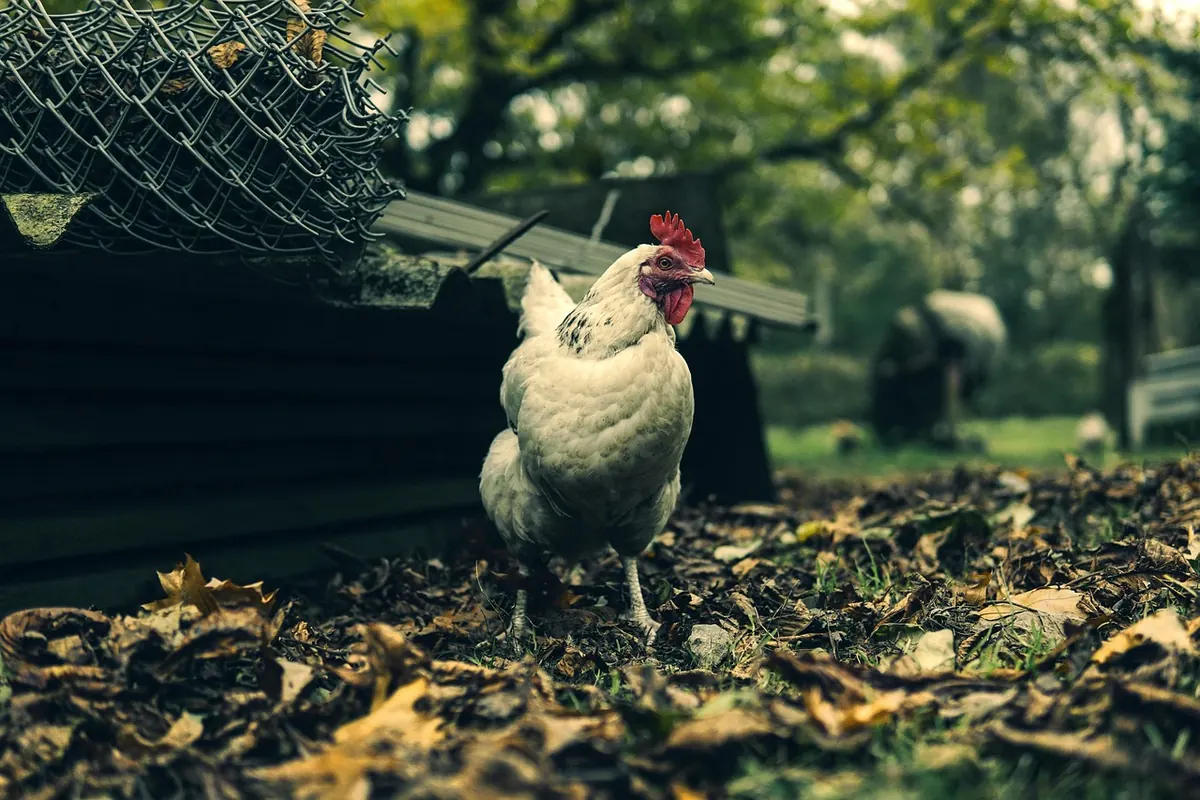
Chickens are the gateway livestock of the smallholding. They cost little to keep, turn kitchen scraps into eggs, and make a place feel properly lived-in. They are also the animals most often kept on assumption rather than observation: a coop bought in a hurry, a run built to fit the space left over, feed stored wherever a sack will sit. The good news is that the same handful of mistakes turn up again and again, and every one of them is cheaper to prevent than to repair.
The classic error is siting the coop on the flattest, nearest patch of ground. That patch is usually the lowest point of the plot, and by November it holds water like a saucer. Add a pop hole facing the prevailing wind and you have a run that turns to liquid mud, hens standing in wet litter, and a smell you can detect from the gate.
The other version of the same mistake is distance. A coop at the far end of a field looks charming in June and gets checked properly in February only by people with better discipline than most of us. If your evening check means boots, a torch and a two-minute walk, it will be skipped on the nights it matters most.
If you can, put the coop on a hard-standing or a thick layer of bark and gravel, and give the run a roof over at least part of it. Dry, draughty-free and shaded in summer beats picturesque every time.
Chicken wire keeps chickens in. It does not keep foxes out. A determined fox will tear it, crush it or dig beneath it, and it will do so at four in the morning when you are asleep. Run mesh with small welded squares, fixed to a solid frame, is a different material entirely, and it is what you want around anything you care about.
Then look for the gaps, because gaps are how predators actually get in. Walk the perimeter once a week and check the base of the fence, the corners where panels meet, the top of the run if you have bantams or chicks, and the latch on the coop door. A simple bolt that a bird cannot nudge open, or ideally a lock, is worth more than another foot of fence height. Foxes climb. Rats burrow. Your own dog will happily investigate a flimsy pop hole.
Predator protection is not fence height. It is the absence of gaps.
Feed left in an open sack inside the coop is an invitation. Rats and mice move in for the pellets, then stay for the eggs and the chicks, and they bring company in the form of parasites and contamination. Once rodents are living in your setup, you are no longer keeping chickens so much as running a buffet with a side of poultry.
Keep feed in metal bins with tight-fitting lids, in a dry, cool store away from bedding. Buy what you will use in a few weeks rather than a pallet that sits over winter, and never let a spill sit on the floor overnight. Damp feed goes mouldy, and mouldy feed can carry toxins that will do real harm, so throw out anything that smells musty or clumps together rather than picking out the worst of it.
At the feeder itself, give birds what they will clear in a day. Heaped hoppers waste feed, attract rats and go stale. Keep grit and oyster shell available in separate small containers, and site drinkers so they cannot be tipped into the litter.
Most first flocks grow faster than the housing does. Hens bought in spring because the coop looked roomy in March are crowded by autumn, and crowding turns small problems into flock problems: pecking, feather loss, dirty litter, respiratory trouble and red mite, which lives in coop crevices rather than on the birds and is far easier to prevent than to clear.
As a rough starting point, allow around 25cm of perch per bird and roughly a square metre each in a covered run, more if the birds are not free-ranging. Treat those as a floor, not a target, and give more space the moment you see tension in the flock.
Handle your birds often enough that handling is not a crisis. A quick weekly routine catches most trouble early.
New birds should be kept separate for a few weeks before they join the flock, with their own feeder and drinker. Keep a small isolation pen ready for a bird that looks off colour, so you are not improvising with a dog crate at ten at night. If a bird is genuinely unwell and you are unsure what you are dealing with, a poultry-friendly vet is worth finding before you need one; anything involving medication is best decided with professional advice.
Lock up at dusk. Break the ice on winter mornings, and keep two drinkers so one can thaw while the other is in use. Give shade in summer and a dust bath of dry soil, sand and a little wood ash. Collect eggs daily so nobody develops a taste for them. And decide early whether your hens free-range, because if they do, they will find the vegetable bed, and no amount of netting draped over seedlings will entirely convince them otherwise.
Start with a few hens rather than a flock. Get the coop sited and the run secure before you buy birds, not after. Walk the perimeter once a week, keep the feed in metal, and write down anything odd you notice, because a hen that stopped laying in March is worth remembering in June.
Almost every mistake in this list comes from convenience quietly beating observation. Fix them in your first season — dry ground, no gaps, secure feed, birds in your hands regularly — and the flock settles into what it should be: the easiest and most rewarding part of the holding.
Photo: marcinw / Pixabay
A practical checklist of the rural waste mistakes that cost you time, money and good neighbourly relations — from...
A practical guide to when muck goes on, how to get it right for your soil, and the local rules worth checking first.
Hedges, post-and-rail, stock netting and dry stone walls each suit different jobs — here is how to pick the one your...


A cozy nook for countryside living and nature..
